Summary
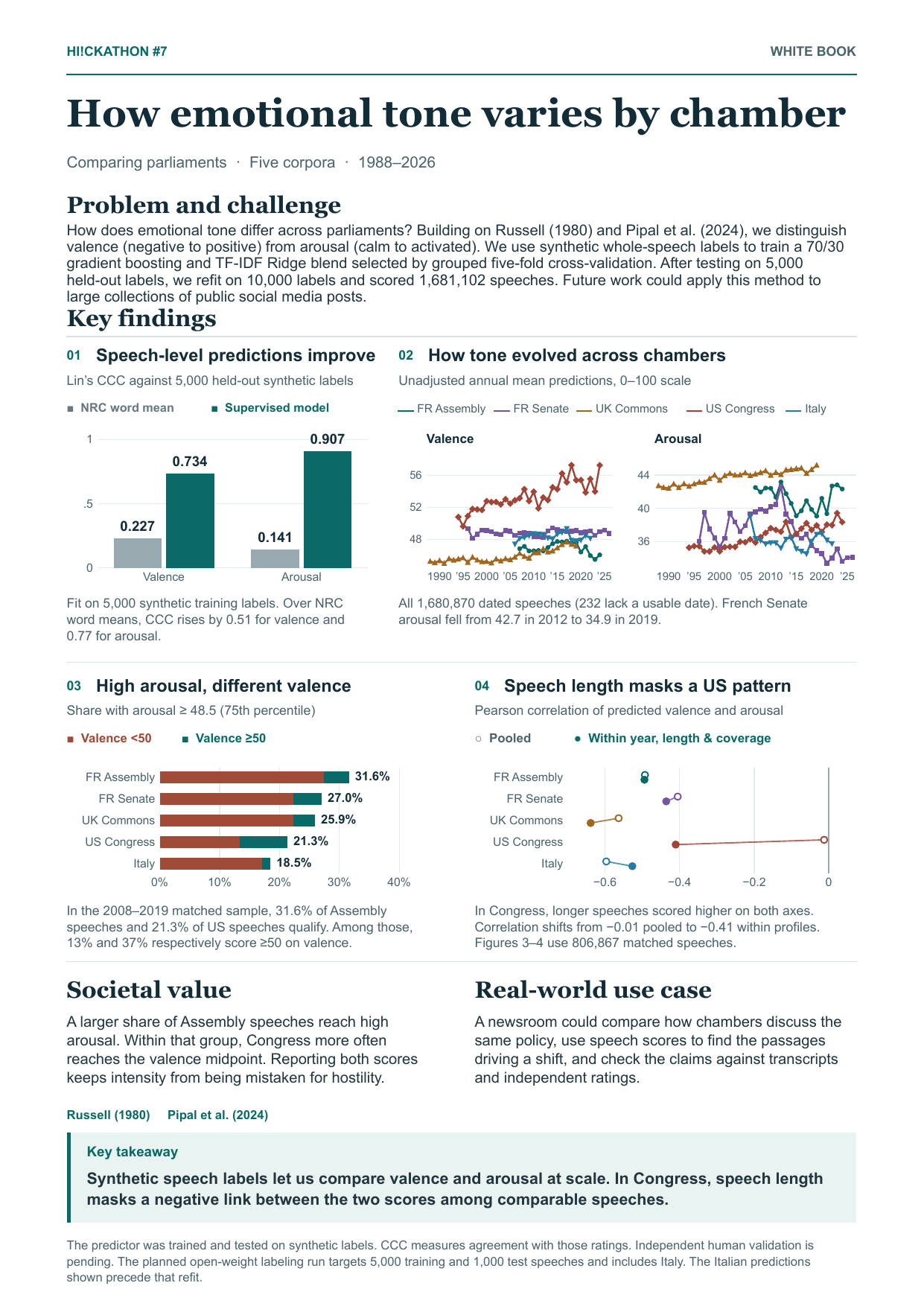
We compare the predicted emotional tone of speeches in five parliamentary corpora, scoring valence and arousal separately for 1,681,102 speeches. The predictor is trained and tested on synthetic labels: on 5,000 held-out labels, Lin’s concordance correlation coefficient (CCC) is 0.734 for valence and 0.907 for arousal. In the US Congress, speech length masks a negative link between the two scores among comparable speeches. Independent human validation is pending.
1. Question
How does emotional tone differ across parliaments? Building on Russell[1] and Pipal et al.[2], we distinguish two dimensions of each speech:
- Valence runs from negative to positive.
- Arousal runs from calm to activated.
The two are measured separately because an intense speech is not necessarily a hostile one.
2. Method
Synthetic ratings of whole speeches serve as labels. A 70/30 blend of gradient boosting and TF-IDF Ridge regression is selected by grouped five-fold cross-validation on 5,000 training labels, then tested on 5,000 held-out labels. It is finally refit on 10,000 labels and applied to 1,681,102 speeches.
Agreement is measured with Lin’s CCC[3]. For predictions x and reference ratings y:
A value of 1 means perfect agreement. Unlike an ordinary correlation, the coefficient also falls when the predictions have a different mean or spread from the reference ratings.
3. Results
3.1 Speech-level predictions improve
Over NRC word means, CCC rises by 0.51 for valence and 0.77 for arousal (Table 1).
| Method | Valence | Arousal |
|---|---|---|
| NRC word mean | 0.227 | 0.141 |
| Supervised model | 0.734 | 0.907 |
3.2 How tone evolved across chambers
The corpora cover different periods. French Senate arousal fell from 42.7 in 2012 to 34.9 in 2019 (Figure 1).
(a) Valence
(b) Arousal
Show the data
3.3 High arousal, different valence
In the 2008–2019 matched sample, 31.6% of French Assembly speeches and 21.3% of US speeches reach high arousal. Among those, 13% and 37% respectively score at least 50 on valence (Figure 2).
Show the data
3.4 Speech length masks a US pattern
In Congress, longer speeches scored higher on both axes. The correlation between valence and arousal shifts from −0.01 when all speeches are pooled to −0.41 within comparable profiles (Figure 3).
Show the data
4. Discussion
Synthetic speech labels let us compare valence and arousal at scale. In Congress, speech length masks a negative link between the two scores among comparable speeches.
Societal value. A larger share of French Assembly speeches reach high arousal. Within that group, speeches in the US Congress more often reach the valence midpoint. Reporting both scores keeps intensity from being mistaken for hostility.
Real-world use. A newsroom could compare how chambers discuss the same policy, use speech scores to find the passages driving a shift, and check the claims against transcripts and independent ratings. Future work could apply this method to large collections of public social media posts.
5. Limitations
- The predictor was trained and tested on synthetic labels. CCC measures agreement with those ratings, and independent human validation is pending.
- The scores describe the predicted tone of speeches. They are not a judgement about any individual speaker.
- The annual means in Figure 1 are unadjusted.
- The planned open-weight labelling run targets 5,000 training and 1,000 test speeches and includes Italy. The Italian predictions shown here precede that refit.
White Book
The one-page version of this work: open the PDF or download it.
References
- Russell, J. A. (1980). A circumplex model of affect. Journal of Personality and Social Psychology, 39(6), 1161–1178. doi:10.1037/h0077714
- Pipal, C., Bakker, B. N., Schumacher, G., & van der Velden, M. A. C. G. (2024). Tone in politics is not systematically related to macro trends, ideology, or experience. Scientific Reports, 14, 3241. doi:10.1038/s41598-023-49618-9
- Lin, L. I.-K. (1989). A concordance correlation coefficient to evaluate reproducibility. Biometrics, 45(1), 255–268. PubMed 2720055